When products look the same, brands win
When products start to look the same, technical information can only take you so far. Scott McCubbin explores how a compelling brand can give specifiers a reason to choose your product – and help that choice stick.

Imagine you’re a specifier choosing between two building products.
Both meet the specification.
Both have the right certifications.
Both perform as promised.
Both have good technical support.
On paper, there’s very little between them.
So which one do you choose?
That’s a problem specifiers face all the time.
Building product manufacturers can provide all the technical information needed to make a decision. But when products start to look similar on paper, technical information alone doesn’t always make the choice any easier.
Manufacturers need to give specifiers a reason to choose their product over another technically credible option.
And that means finding the difference that matters — then making it visible, meaningful and easy to understand. That means they need a compelling brand.
When technical claims start to blur
Building product manufacturers have plenty of things they can prove – from quality to performance through to innovation and sustainability. But they’re not differentiators.
If everyone in the category says the same things, those claims become more like the price of entry than a reason to choose one brand over another.
So that’s when the question changes.
Not “Can this product do the job?”
But: “Why would I choose this one?”
And that’s a much harder question to answer with a datasheet.
Find the difference that matters
The answer isn’t to invent a more interesting claim. It’s to work out what genuinely makes your business, product or approach different — and why that difference matters to the people making the decision.
That could be:
- more design freedom
- easier installation
- specialist technical expertise
- better support through specification and delivery
- a distinctive approach to sustainability
- solving a particular problem better
- experience in a particular application
- a service model competitors struggle to match
But a difference isn’t automatically a differentiator. The question is whether anyone cares.
An architect might value design flexibility.
An estimator might care about cost and availability.
A project manager might care about reliability and support.
An installer might care about ease of installation.
So the job is to find the sweet spot between what you’re genuinely good at and what matters to the people choosing you.
Turn product features into reasons to choose
A lot of building product marketing stops at the feature:
’Patented installation system.’
’High-performance material.’
’56 finishes.’
Useful information. But it doesn’t necessarily give someone a reason to care. The job of brand is to connect the technical truth to something meaningful – which is exactly what we did for Amtico Marine.
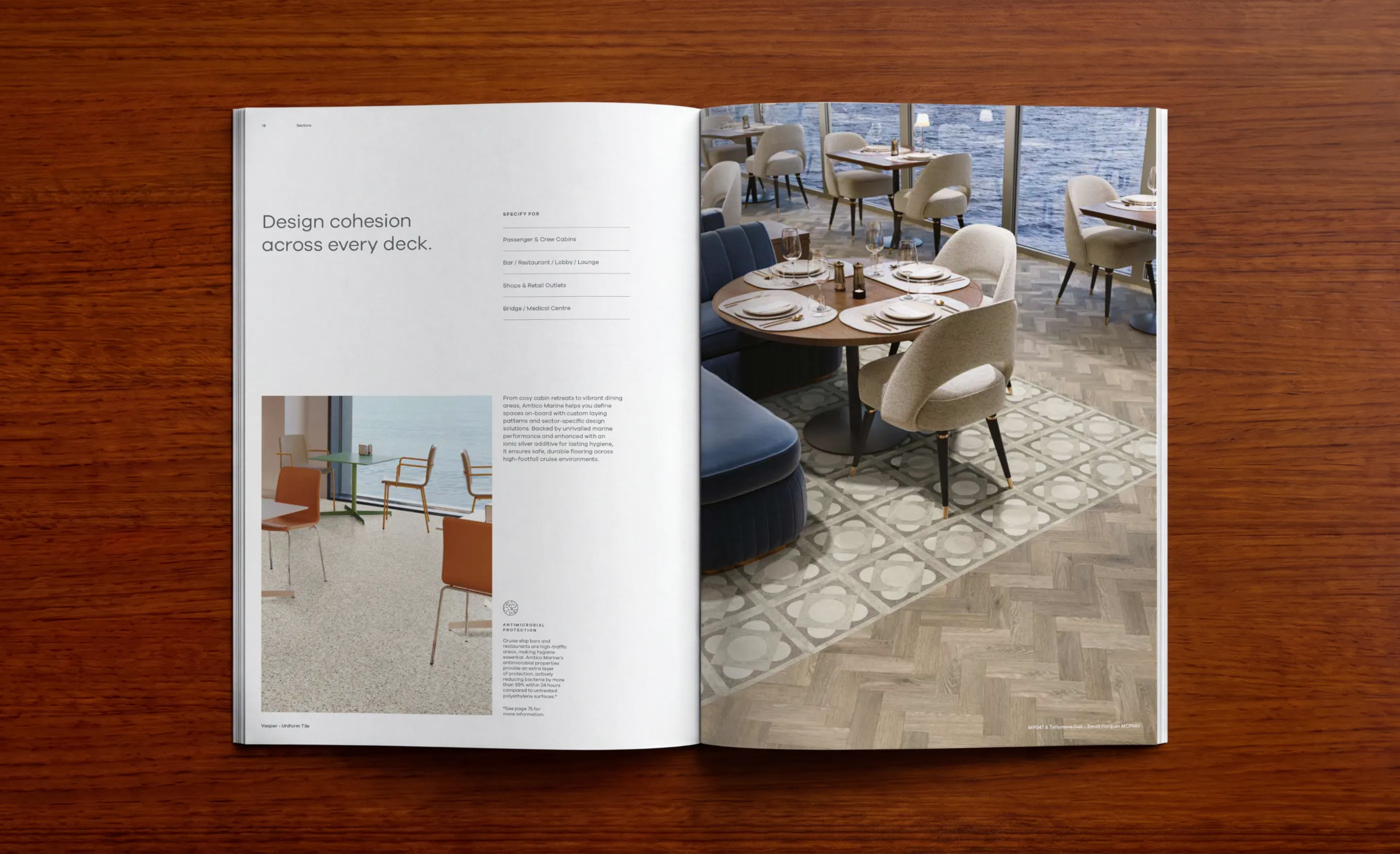
The marine collection offers 56 wood and stone designs, alongside the performance characteristics needed for marine environments. But the opportunity wasn’t simply to communicate those features. It was to move the conversation beyond compliance, safety and durability towards what those choices give maritime architects: design freedom.
The technical truth stayed exactly the same. What changed was what it meant to the person choosing it.
Preference matters when the spreadsheet comes out
If two products appear to do the same job, price becomes an easier comparison. And as a project moves towards tender, procurement and construction, choices can be challenged, substituted or value engineered.
Brand can’t make those pressures disappear. But it can give people another reason to hold onto a choice.
And it’s particularly relevant when technical credibility is already a given. In US research from The Farnsworth Group’s 2026 Building Products Customer Guide, 49% of architects surveyed ranked brand reputation and familiarity among the most important factors when selecting building products, alongside things such as product quality and manufacturer support.
In other words, being technically credible gets you into the conversation. Being a brand people recognise, trust and prefer can influence what happens when there is a choice to make.
A difference isn’t much use if nobody can see it
Finding your difference is only the beginning.
It needs to show up consistently in the places people experience your brand.
- Your website
- Your technical information
- Your CPDs
- Your samples
- Your case studies
- Your sales team
- Your specification tools
- Your support
If your positioning says one thing but the experience says something else, the difference disappears.
Building products get specified. Brands get chosen
You don’t need to invent a difference nobody else has. You need to find the difference that matters, make it meaningful to the people choosing your products, and prove it consistently.
Because when building products start to look and sound the same, technical credibility can only take you so far. Building products get specified.
Brands get chosen.