The inside track: Scott Farrar
What does it take to get a product specified – and, more importantly, keep it in the building? For Scott Farrar, Associate Technologist at Scott Brownrigg, the answer goes well beyond good design. Working across commercial retrofit and carbon reduction, Scott sees first-hand how technical performance, commercial pressures, contractor relationships and sustainability ambitions influence decisions. Scott McCubbin caught up with him to explore the realities of specification, the challenges facing manufacturers and what it takes to turn a promising product into a practical choice.
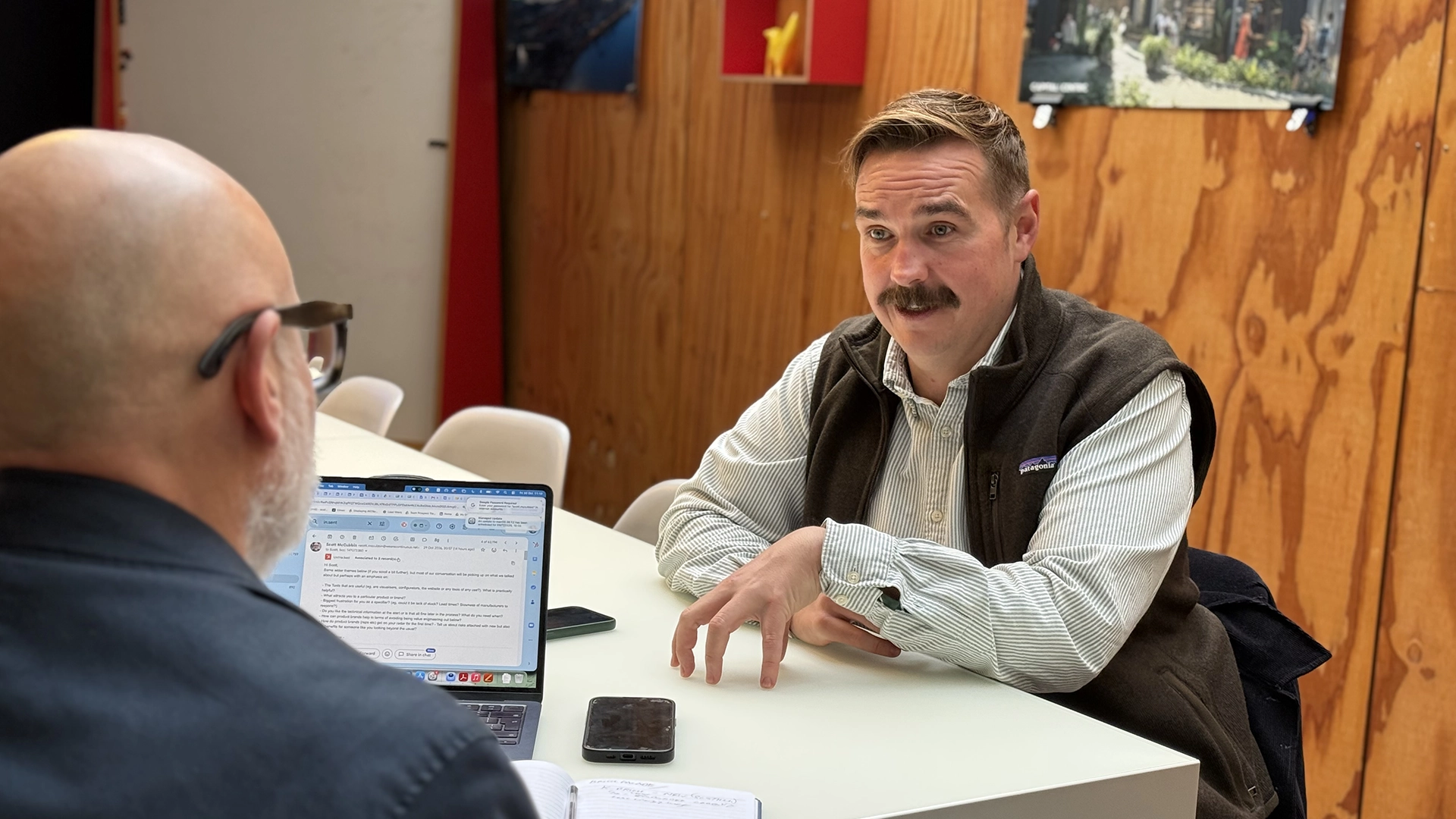
About Scott
Scott is an Associate Architectural Technologist and Sustainability Lead at Scott Brownrigg, where he leads large-scale commercial retrofit projects and drives the practice’s carbon reduction strategy. He specialises in sustainable design, whole-life carbon analysis and the reuse of existing buildings, and is also an active member of Don’t Waste Buildings, advocating for greater industry collaboration and a shift towards retrofit as a key part of creating a more sustainable built environment.
You’re working across both project delivery and sustainability. Can you tell us a little about your role and how those two areas come together?
I’m an Associate Technologist in the commercial team at Scott Brownrigg, where I lead the delivery of a number of commercial retrofit projects.
My background is in architectural technology, so I tend to pick projects up around Stage 3, when the early design starts becoming something that can actually be built. It’s about taking the design intent and developing the technical detail, working through materials and products, and making sure everything is compliant and buildable.
I’m also one of the practice’s sustainability leads and head up our carbon reductions work. That looks at everything from low-embodied-carbon design strategies to helping the practice meet its net-zero carbon targets.
Outside the practice, I’m involved with Don’t Waste Buildings, a campaign group looking at best-practice retrofit and the barriers preventing more buildings from being reused.
The two roles are quite closely connected. I’m passionate about retrofit because the most sustainable building is often the one that’s already there. It’s about looking at what you’ve got, understanding what the client wants to achieve and finding creative ways to bring those things together.
You describe yourself as someone who questions sustainability claims. Why is that important?
I was hearing a lot of people saying, ”My building is net zero carbon”, and thinking, how is that possible? You’ve got all this cement, concrete, steel and glass. How can that be net zero?
Often, what they actually meant was net-zero energy, which is a different thing entirely.
That was what prompted me to do a master’s in Sustainable Building Design. I wanted to understand the practicalities of designing a genuinely net-zero-carbon building, particularly the embodied carbon of materials.
You have to be really careful about what you’re claiming. Everything has an impact, and you can lose your credibility if you say you’ve designed a net-zero-carbon building when someone can demonstrate that you haven’t.
It’s also about protecting the practice from greenwashing. We need to question things, understand the evidence and make sure we’re making informed decisions.
You mentioned that specification itself can become a barrier to retrofit. What’s behind that?
A lot of products have test data based on new-build conditions. Manufacturers know what substrate their product is being fixed to, and they have standard details that have been tested and signed off.
But in retrofit, you’re dealing with an existing building. You might not know exactly what’s behind a wall or what the original construction looks like. You’re trying to introduce a product into a situation that isn’t necessarily covered by the manufacturer’s test data.
We had an example on a current project where we wanted to retain an existing fire protection system on the steel frame and simply patch it where needed. That would have saved the client money and reduced the carbon impact.
However, the manufacturer didn’t have test data for the particular wall and beam interface we were dealing with. The contractor wasn’t prepared to take the risk, so we ended up having to use a different fire protection system, boxing out the steel.
That cost the client hundreds of thousands of pounds and introduced additional material and carbon into the project.
It’s a good example of how a lack of testing or technical reassurance can actually prevent us from making more sustainable decisions. We need manufacturers to be more open to testing products in different conditions and helping us find solutions for existing buildings.
How much harder has it become to protect the products you’ve specified from being value engineered out?
Significantly harder. I’ve worked on four commercial projects in the City of London over the last four years, and on my last three, practically every package has gone through value engineering. Facades, flooring, ceilings, furniture, fixtures and fittings – everything.
We still specify what we want, and we design all the interfaces and details around those products. But by the time the contractor gets involved, there can be a lot of pressure to find savings.
On a design and build contract, there’s usually a two-stage tender process. The contractor prices the project based on our specification, but before they enter into the final contract, there’s a period where they review the information and look for opportunities to reduce costs.
That’s when a lot of substitutions happen. We might have specified a particular system, but the contractor comes back with an alternative that’s 50% cheaper. We have to assess whether it’s genuinely equivalent and advise the client, but ultimately the client can decide to accept the saving.
And that’s the frustration. We’ve spent time developing the design around a particular product, and suddenly we’re having to reconsider all of that.
I think manufacturers need to understand that this is happening on almost every project now. They need to think about how they protect their position beyond the initial specification.
So what can manufacturers do to make it harder for a contractor to substitute their product?
They need to help us demonstrate why their product is better than the cheaper alternative.
In our specifications, we have to include an ‘or equal and approved’ clause. We can’t simply insist on a particular brand. But if we can identify specific performance characteristics that make Product A different from Product B, we’ve got something tangible to assess an alternative against.
The problem is that manufacturers often leave us to do that research ourselves. We’ll have pages and pages of technical information to work through, and we’re incredibly busy. If a contractor proposes an alternative, I need to be able to look at it quickly and understand whether it genuinely meets the specification.
Manufacturers could help by doing that comparison themselves. Look at your competitors, understand where your product performs better and give us the information we need to justify keeping it.
And it’s not just about technical specifications. I want case studies, samples, EPDs, sustainability information and circularity data. If you’re asking me to specify a product I’ve never used before on a 700-unit residential development, I need to understand why I should take that risk.
You have to prove the quality and demonstrate the value.
Does that mean manufacturers need to spend more time building relationships with contractors and quantity surveyors, rather than concentrating on architects and designers?
Absolutely. I think manufacturers are very focused on getting architects and interior designers on side, which is important because we’re the people specifying the products in the first place.
But they need to engage with the other people in the design and construction team, particularly contractors, quantity surveyors and their costing teams.
Contractors are naturally risk averse. They’re responsible for delivering the project, and they’re going to gravitate towards products and manufacturers they know. If they’ve never heard of a product we’ve specified, they might be nervous about using it, particularly in an existing building where there are already so many unknowns.
They also have their own supplier relationships. A quantity surveyor might have 10 projects with one contractor and access to a supplier who can offer a better deal across all of them.
Manufacturers need to understand those relationships and work out how they can become part of them. That might mean building longer-term relationships with contractors, understanding their pipeline or finding ways to be more competitive across multiple projects.
It’s not enough to convince the architect that your product is brilliant. You need the whole team to understand why it should be used.
What makes a manufacturer genuinely useful to you during a project?
Technical support, without a doubt. I need people who understand their products inside out and can help me solve problems.
Take fire protection, for example. If I’m specifying a beam encasement that needs to achieve a two-hour fire rating, I need to understand exactly how that system works with the existing structure. In retrofit, I might not know what the soffit is made of or what its fire performance is.
I need to be able to pick up the phone or email someone and ask, “What do you think about this detail? Is there test data to support it?"
There are some fantastic technical people in the industry. The teams I’ve worked with at companies like Promat and British Gypsum are great because I know who to contact, they understand the products and they’ve often spent years on site. They can look at a tricky condition and give me a practical answer.
Sometimes they’ll tell me there’s no test data and we’ll have to find another solution. That’s still valuable because it means we’re making an informed decision.
Those relationships make a huge difference. If I have to contact someone I’ve never spoken to before and spend half an hour explaining the project, it’s much harder to get the answer I need.
How can a manufacturer with a new or emerging product compete with the established names?
They need to give me a reason to look beyond the products I already know and trust.
If a new drylining company approaches me and tells me they’ve got a particular acoustic rating, that’s great, but so does British Gypsum. Why would I change? What makes you different?
The products that really get my attention are those that solve a problem or offer something genuinely innovative.
One example is K-Briq, which is a brick made from construction and demolition waste. It has the same density and weight as a traditional brick, but because it doesn’t need kiln firing, it has around 90% less embodied carbon.
I’ve been trying to get that specified on projects because it’s a great example of reducing the carbon impact without completely reinventing the way we build.
I came across it while researching lower-carbon alternatives for a practice-wide embodied carbon benchmarking study. It immediately caught my attention, and I’ve been looking for opportunities to use it ever since.
The challenge is that it’s a relatively new product. There aren’t enough completed projects to give clients the reassurance they want, and scalability has been an issue. We had a large residential project that wanted to use it but couldn’t get the supply volumes required.
That’s the reality for emerging products. You need to demonstrate that they work, that you can supply them at scale and that the contractor can build with them.
What about the way manufacturers present their products? Are digital tools, visualisers and samples useful?
Visualisers and configurators are great, particularly for internal finishes. If I can put a room into a tool and experiment with different colours, materials and finishes, that’s really useful. It gets a designer’s attention, and if I can upload a 3D model of the actual space, even better.
But those tools are only one part of the picture.
For me, having a physical person to talk to is more valuable. I need someone who can answer the technical questions, explain how a product performs and tell me what’s inside it.
I had someone come in recently to present some timber ceiling elements. They looked beautiful, had a timber veneer and were marketed as a sustainable acoustic solution. But when I asked about the acoustic ratings and the composite build-up, they couldn’t tell me.
They knew about the aesthetic finish, but I needed to know what was underneath it. Was it plywood? What else was in the product? What was its performance?
A concept designer might love the look of it, but my job is to make sure that design becomes compliant and buildable. I need both sides of the story.
You mentioned that you want to see more problem-solving from manufacturers. What would that look like in practice?
We’re looking at introducing a regular emerging products and materials session within our practice, alongside our more formal CPD programme.
What we’d want manufacturers to bring is a problem they’re solving. Not just a sales pitch about how brilliant their product is.
For example, how does your product help me achieve a lower embodied carbon target? Does it improve acoustic performance? Can it help us overcome a particular challenge with an existing building?
And it’s a two-way conversation. Manufacturers need to understand the problems we’re facing, and we need to understand how their products might help us solve them.
I think there’s an opportunity for the industry to do more research into this as well. Industry bodies could be doing more to understand the barriers designers and manufacturers face and sharing that knowledge across the supply chain.
We also need to bring more people into the conversation. It’s not just architects and manufacturers. Quantity surveyors, project managers and contractors all have their own networks and influence over what gets bought.
Finally, if you could give manufacturers one piece of advice about getting their products specified, what would it be?
Don’t just sell me your product. Help me solve a problem.
Understand what we’re trying to achieve, give us the technical information to support it and make it easy for us to demonstrate why your product is the right choice.
Be upfront about lead times, understand your competitors and show us where you genuinely offer something better. And don’t stop building the relationship once you’ve got the product into the specification. You need to keep talking to the contractor and the wider project team.
Ultimately, we’re all trying to deliver a good building. If you can help us do that, you’ll get our attention.
Thank you Scott for taking the timeout to talk to us.